A meeting becomes difficult to change after the invitation, room, agenda, and materials are fixed. An access brief moves the important questions earlier. It is a short planning document about participation: who needs to do what, through which channels, with what support, and who will resolve an unanswered question. It is not a request for colleagues to disclose diagnoses.
Boston's Office of Language and Communications Access describes interpretation, translation, and assistive technology as distinct areas of support. The Massachusetts DPH planning guide covers the full event, including facilities, travel, timing, communication, staffing, and presenters. Those public resources support a wider planning lens than simply asking whether a room has a ramp. Boston: Language and Communications Access Massachusetts DPH: Planning Accessible Meetings and Events
Begin with the work people will do
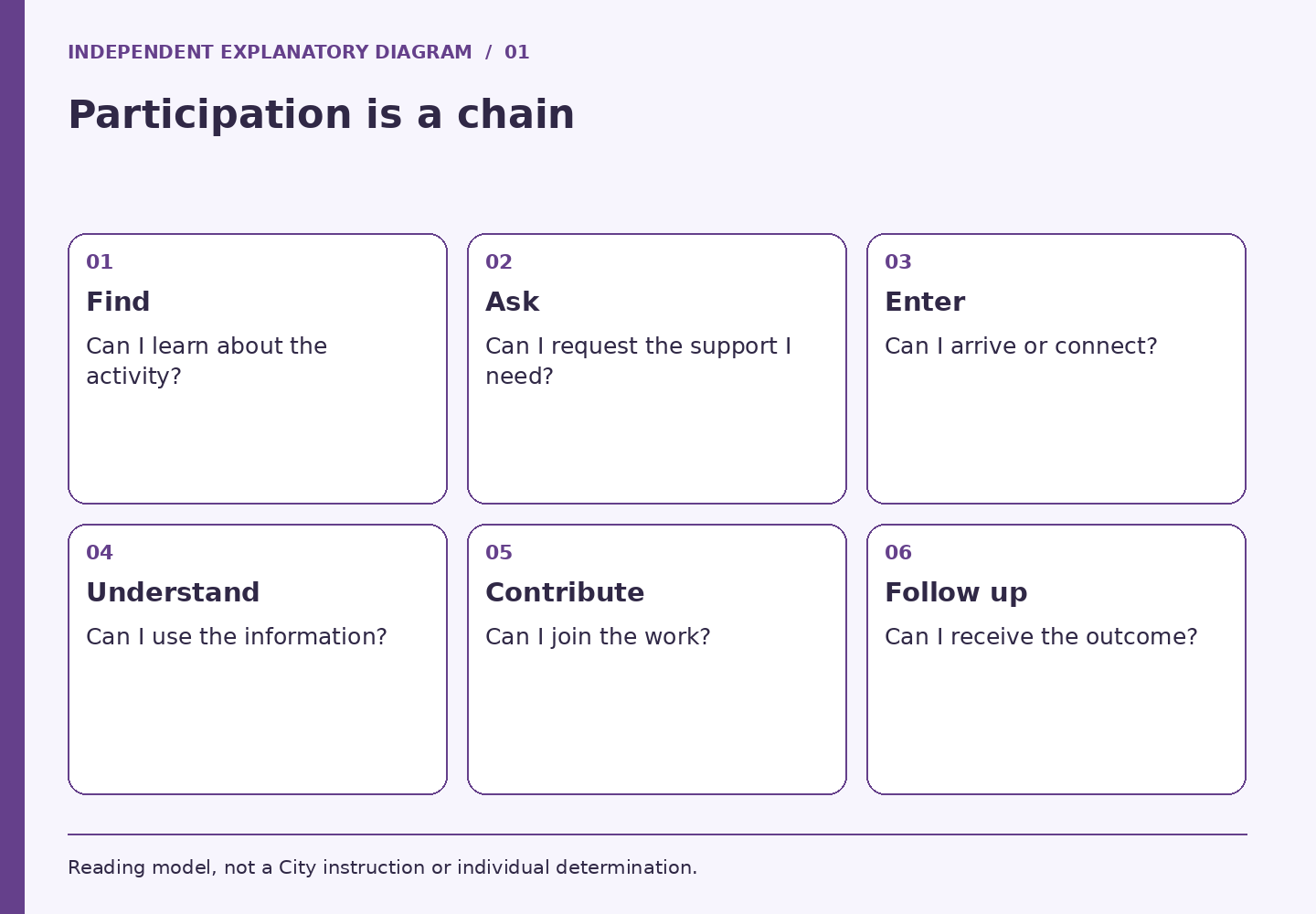
Write the intended participant actions in ordinary verbs. For a training session these might be: find the invitation, open the handout, hear or read the explanation, try an exercise, ask a question, and receive a useful answer afterward. For a public workshop, add the method for contributing an idea and learning what happened to it. Each verb exposes a different possible barrier.
Do not list “accessible” as a single completed task. A registration page, building entrance, presentation, and feedback form can fail independently. Assign one owner to each part and name the evidence that will show readiness. “Room confirmed” is weak evidence; “event lead completed the route walkthrough and resolved the entrance question” is more useful.
Separate defaults from individual arrangements
Some improvements belong in the standard setup: readable invitations, understandable directions, usable documents, and clear ways to ask questions. Other arrangements need a conversation with the person requesting them and the authorized service provider. Keep these connected without putting private information into the general project plan.
Use a limited-access process for actual requests. The shared planning sheet can say that an arrangement is awaiting confirmation, who owns that confirmation, and what event component depends on it. It usually does not need the person's medical history or the reason for the request. Ask the responsible office what documentation belongs in its approved channel.
Work a small fictional case
A fictional team plans a two-hour orientation with a tour and group exercise. Its first draft says only “meeting room booked.” The access brief reveals three additional decisions: whether the tour route is usable, how a remote participant can join the exercise, and whether handouts will be ready for requested formats before the session.
The team assigns the route to the facilities contact, the remote exercise to the facilitator, and the handouts to their author. It places these tasks before the invitation release. If the tour cannot provide comparable participation, the organizer asks the responsible accessibility staff about alternatives rather than quietly leaving one participant behind.
Close the brief with five checks
- Participation: every required activity has a usable method and an owner
- Communication: needed language and communication services have a verified request route
- Timing: materials and technical tests happen early enough to make corrections
- Privacy: individual requests stay out of broadly shared planning notes
- Follow-up: someone checks whether the arrangement actually worked
The Boston LCA Hub currently directs staff to review the current project funding process. Confirm current departmental steps rather than copying an old project budget or treating this article as purchasing authority. A good brief ends with named decisions that remain open, not an unsupported declaration that the event is compliant. Boston LCA Hub: Liaisons and Specialists
LOCAL READING AID / NO PERSONAL INPUT
Participation Readiness Map
Choose a work product and the stage of participation. Get a practical plan, focused review questions, and a route to the official source. No personal information is requested.
Read the method without JavaScript
Choose a work product and the stage of participation. Get a practical plan, focused review questions, and a route to the official source. No personal information is requested.
- Boston: Language and Communications Access: Define every participation activity, including questions and follow-up. Assign owners for the venue route, materials, communication arrangements, and live troubleshooting. Check current departmental LCA steps before committing funds.
- Massachusetts Office on Disability: Tips for hosting accessible events and meetings: Test a room question reaching a remote participant and a remote contribution reaching the room. Test shared files, communication supports, and the breakout activity with a participant account. Name who can pause the session and invoke the agreed fallback.
- Massachusetts Office on Disability: Creating accessible digital documents: Confirm the approved audience, required action, version, and owner. Review structure, meaningful links, and non-text content in the editable source. Reopen the exported file and test the actual distribution link.
- Boston: Language Access Information and Services: Separate live conversation needs from written-material needs. Provide the authorized coordinator with the format, activity, timing, and approved materials. Track source edits across every affected language version and delivery format.
- W3C WAI: Understanding Media Alternative (Prerecorded): Inventory what the lesson communicates through speech, sound, and visuals. Review captions for instruction-changing errors and identify visual meaning absent from the audio. Check the player, companion files, version, and support route as one package.
- City of Boston Employee Handbook: Policies and Procedures: Identify whether this is an employee workplace process, a City-program question, or an operational defect. Use the appropriate official channel for personal supporting information. Assign a repair owner and choose a test that matches the reported participation failure.
Choices stay in page memory. No submission, tool storage or URL change. Browser-managed form restoration may behave independently. External source links follow their own policies. Source context checked October 7, 2026.
Sources and scope
Public sources checked October 7, 2026. The exercises and fictional cases are independent editorial work. This publication cannot certify accessibility, decide an accommodation, or act for the City.
- Boston: Language and Communications Access: Office remit; interpretation, translation, assistive technology; links to employee training.
- Massachusetts DPH: Planning Accessible Meetings and Events: Planning categories include facility, transportation, timing, communication, staffing and presenters.
- Boston LCA Hub: Liaisons and Specialists: Department liaisons and LCA specialists; public page directs staff to review the project funding process.