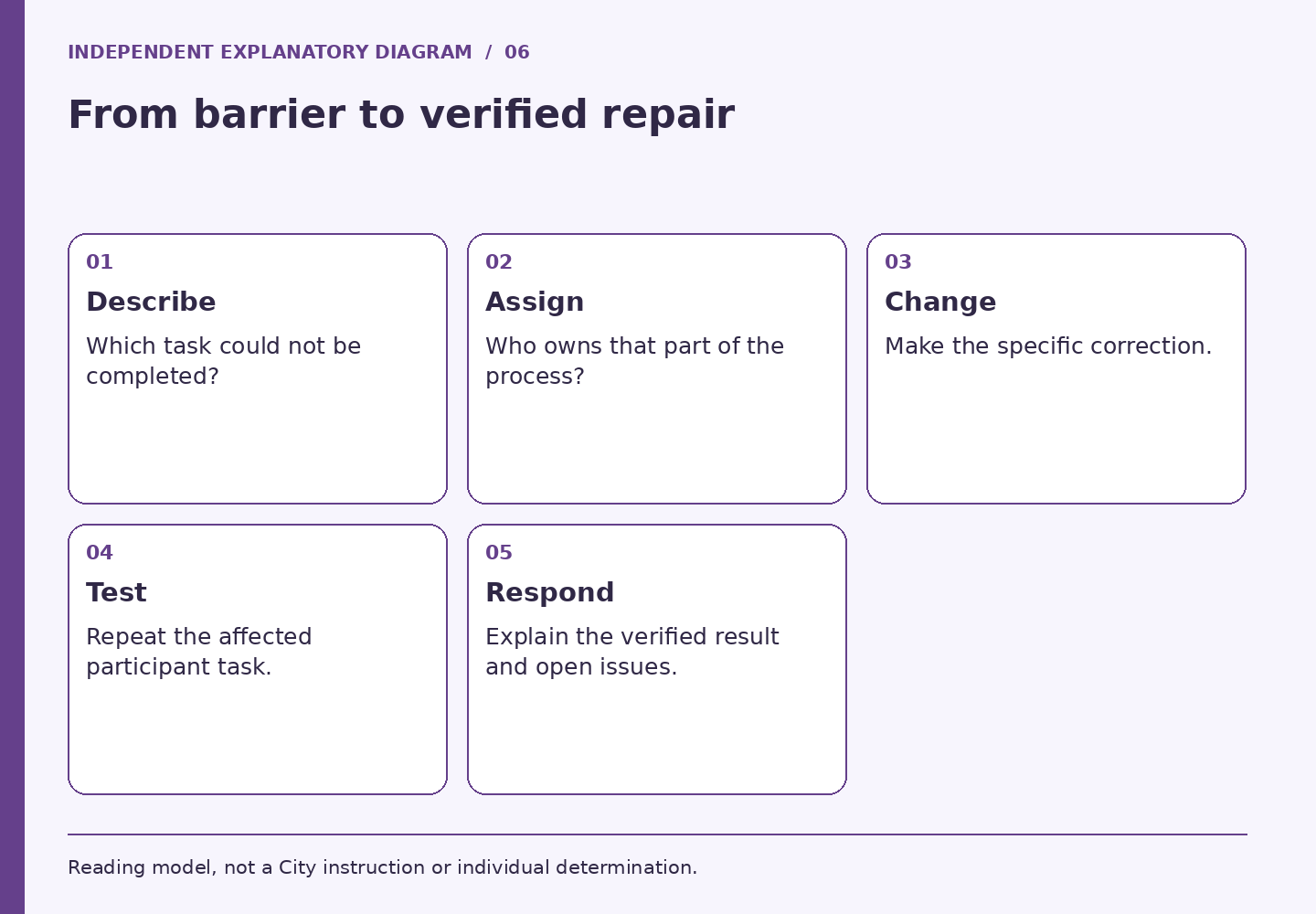
“Thanks for the feedback” is polite, but it does not tell anyone whether a barrier will change. A useful response identifies the affected task, assigns an owner, makes a concrete correction, and checks the result. The process should be simple enough to use after a small team meeting as well as after a larger public event.
Boston's LCA page describes feedback and complaint routes related to language access, and the Disabilities Commission provides public information and referral resources. Use the appropriate official route for a formal concern. The exercise here is an internal improvement method, not a substitute complaint system, legal remedy, or promise of a particular response. Boston: Language and Communications Access Boston: Disabilities Commission
Describe the participation failure
Ask which part of the activity was difficult to access and what the person was trying to do. An observation such as “I could not hear audience questions while joining remotely” is actionable. A broad label such as “the technology failed” may conceal several different causes.
Do not require the person to supply a diagnosis or solve the problem before you will record it. If they volunteer a preferred solution, include that information through the appropriate process. Keep sensitive individual details separate from a broadly shared project retrospective.
Assign the repair to the part of the system that owns it
A microphone problem may belong to the meeting setup; a missing document structure may belong to the authoring process; an outdated translation may belong to release management. Name the responsible role and the next action. “Team to improve access” is too vague to verify.
In a fictional hybrid workshop, remote attendees miss questions spoken away from the microphone. The event team assigns the facilitator to repeat or properly capture questions, the technical owner to test the room setup, and the organizer to incorporate the test into the next rehearsal. The repair has several owners because the barrier had several causes.
Define evidence before closing the item
A purchase order for new equipment is not proof that the next meeting will work. An edited document is not proof that the published link points to it. Choose a practical test that matches the reported failure: join remotely and ask a room-based question, open the corrected file, or follow the updated multilingual notice to its destination.
The Massachusetts event guidance covers access across in-person, virtual, and hybrid participation. Use that broad scope to avoid fixing only the easiest visible part. An improved camera does not resolve a missing way to contribute. Massachusetts Office on Disability: Tips for hosting accessible events and meetings
Reply in a way the person can use
When appropriate, tell the person what changed, what remains unresolved, and how to report a continuing problem. Avoid saying “fixed” when you have only sent the issue to someone else. Distinguish the referral, the planned change, and the verified result.
If the issue belongs in a formal process, explain the official route without discouraging the person from using it. Do not imply that participating in an informal improvement conversation waives any other option. This publication cannot assess rights or deadlines in an individual situation.
Carry the lesson into the next event
Update the template, checklist, or role assignment that would prevent the same problem. Keep a short non-personal record of the barrier, repair, test, and date. Review recurring failures to see whether the underlying process still needs work. The measure of progress is whether people can participate more reliably, not how many feedback entries have been marked complete.
LOCAL READING AID / NO PERSONAL INPUT
Participation Readiness Map
Choose a work product and the stage of participation. Get a practical plan, focused review questions, and a route to the official source. No personal information is requested.
Read the method without JavaScript
Choose a work product and the stage of participation. Get a practical plan, focused review questions, and a route to the official source. No personal information is requested.
- Boston: Language and Communications Access: Define every participation activity, including questions and follow-up. Assign owners for the venue route, materials, communication arrangements, and live troubleshooting. Check current departmental LCA steps before committing funds.
- Massachusetts Office on Disability: Tips for hosting accessible events and meetings: Test a room question reaching a remote participant and a remote contribution reaching the room. Test shared files, communication supports, and the breakout activity with a participant account. Name who can pause the session and invoke the agreed fallback.
- Massachusetts Office on Disability: Creating accessible digital documents: Confirm the approved audience, required action, version, and owner. Review structure, meaningful links, and non-text content in the editable source. Reopen the exported file and test the actual distribution link.
- Boston: Language Access Information and Services: Separate live conversation needs from written-material needs. Provide the authorized coordinator with the format, activity, timing, and approved materials. Track source edits across every affected language version and delivery format.
- W3C WAI: Understanding Media Alternative (Prerecorded): Inventory what the lesson communicates through speech, sound, and visuals. Review captions for instruction-changing errors and identify visual meaning absent from the audio. Check the player, companion files, version, and support route as one package.
- City of Boston Employee Handbook: Policies and Procedures: Identify whether this is an employee workplace process, a City-program question, or an operational defect. Use the appropriate official channel for personal supporting information. Assign a repair owner and choose a test that matches the reported participation failure.
Choices stay in page memory. No submission, tool storage or URL change. Browser-managed form restoration may behave independently. External source links follow their own policies. Source context checked October 7, 2026.
Sources and scope
Public sources checked October 7, 2026. The exercises and fictional cases are independent editorial work. This publication cannot certify accessibility, decide an accommodation, or act for the City.
- Massachusetts Office on Disability: Tips for hosting accessible events and meetings: In-person, virtual and hybrid event planning; access across participation methods. General guidance, not an event compliance determination.
- Boston: Language and Communications Access: Office remit; interpretation, translation, assistive technology; links to employee training.
- Boston: Disabilities Commission: Architectural, procedural, attitudinal and communication barriers; public referral and architectural-access resources.